
Design for Interaction and Inquiry
- (Ergonomics with a focus on user-centered design and interaction)Design enables us to critically examine the complexities of our world and to intervene in it in a creative way. The field of "Design for Interaction & Inquiry" understands design as a social activity that can be used to negotiate the kind of world we want to live in today and in the future. Design itself, as a discipline and practice, is also questioned and offers a space for creative interventions.
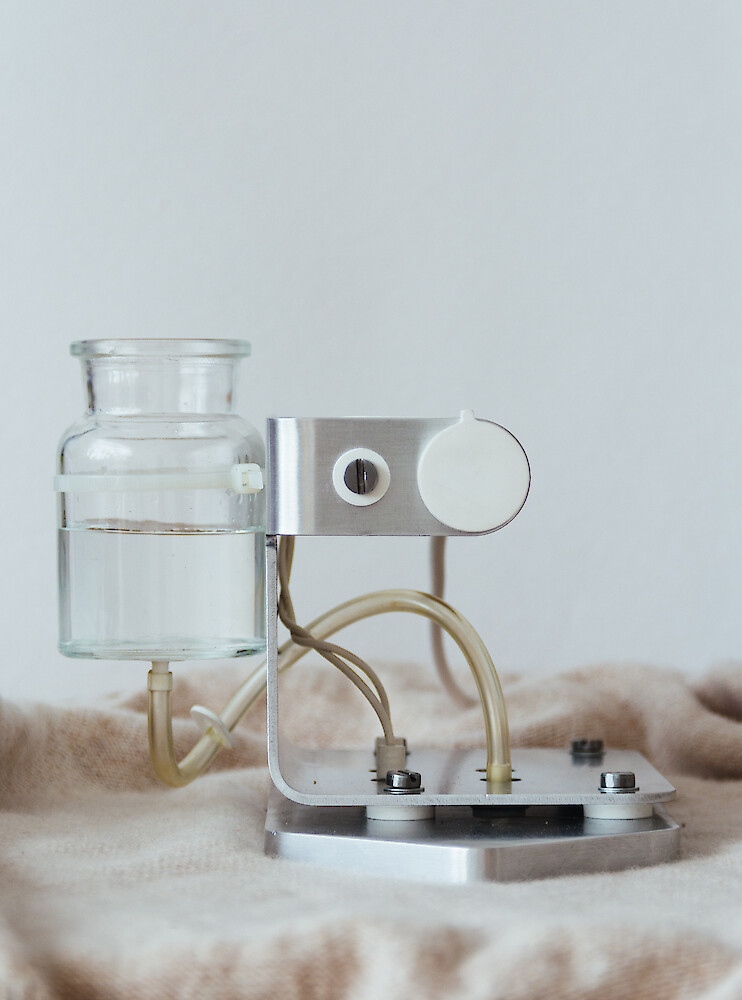
The ergonomics laboratory, which is part of the teaching area, works interdisciplinarily at the interface of experimental interaction design, ergonomics, and biology. The results of the laboratory's work and series of experiments are regularly published in exhibitions and publications. The focus is on the experimental development and practical implementation of designs, prototypes, and models in order to make materialized thought experiments and usage scenarios tangible and to research them. The laboratory pays particular attention to the publication and communication of the resulting work through exhibitions. The laboratory is equipped with tools for implementing designs in wood, metal, and plastic (complementing the university's other model-making workshops) as well as in the associated BioLab with equipment from the field of biology (clean room workbench, incubator, microscope, etc.). In the BioLab, the focus is on the experimental development of bio-based materials and food design.
Image above: Algae for beta-carotene extraction, Hutt Lagoon, Western Australia
Personen

Prof. Dr. Johanna Schmeer
Design for Interaction and Inquiry

Tom Baffi
Wissenschaftlicher Mitarbeiter

Katharina Herbrich
Wissenschaftliche Mitarbeiterin
Forschung
Transfer project "Sustainability by Design" (SBYD)
SBYD researches climate-neutral and resource-efficient ways of living and producing. Knowledge from sustainability research is transferred to society and the economy through design. The ability of design to make theories and abstract concepts tangible—and to transfer them into everyday life—is used to research, discuss, and test these theories and ideas in practice. SBYD is part of the "Innovative University" funding line and will be funded with €5.6 million by the Federal Ministry of Education and Research (BMBF) and the Joint Science Conference (GWK) from 2023 to 2027.

Creative & Critical AI
The aim of the Creative & Critical AI project was to develop and test a digitally supported, transdisciplinary teaching format based on the principle of the flipped/inverted classroom, which offers students the opportunity to acquire skills in the field of digital automation and artificial intelligence and to engage with these technologies in both creative and critical ways.